
Search Results by Intent: Five Pages and the Zero-Click Future SEOs Already Measured
One search box, five different pages, and a zero-click trajectory SEOs were charting a decade before the phrase existed. Click a sector and the result surface redraws to the rates the studies actually measured — then the conclusion asks what optimizing for citation looks like once the gatekeeper is an agent, not a ranking page.
Listen to this article (23 min)
Computer-generated narration (macOS voice “Samantha”). The article text is the transcript.
By Mitchell Miller · ~9 min read · AI search / measurement
Click a sector

TL;DR — three numbers
- 68.01% of US Google searches ended with no click at all, January–April 2026 — up from 60.45% two years earlier. (SparkToro, Similarweb clickstream panel, 9 June 2026.)
- Position-one organic CTR falls 58% once an AI Overview appears on the page — nearly double the 34.5% the same team measured eight months before. (Ahrefs, 300,000 keywords via Search Console, 4 February 2026.)
- SparkToro's own tracker already had zero-click share at ≈45% in 2016. Ten years of the same measurement, not a 2026 discovery.
Five intents, five different pages, five different reasons Google built them that way. Click a sector above or read straight through.
Informational — the cheapest answer to keep in-platform
Scale: Google itself reports more than 5 trillion searches a year, globally (Vidhya Srinivasan, blog.google, 3 March 2025) — no publisher has broken that total down into a US-only, informational-specific share.
36% of informational queries trigger an AI Overview, rising to 85.9% when the query is phrased as a question — "what," "how," "why." (Seer Interactive, 5.47M queries / 53 brands, Jan 2025–Feb 2026, published 24 April 2026.) A separate late-2024 panel put "informational/brand" sub-intent at 69.8%, inside an overall rate of 29.9% of keywords but only 11.5% of search volume (Authoritas, 10,000 US desktop keywords, published January 2025) — a smaller panel than Seer's, not a contradiction.
Citation status decides the click: 3.35% organic CTR with no AI Overview on the page, 2.07% when one appears and you're cited, 0.94% when one appears and you're not — a 3.6× drop for showing up uncited. (Seer Interactive, same study.) Featured snippets fell from 15.41% to 5.53% of desktop SERPs in six months as AI Overviews took the slot (Ahrefs, 1M US desktop SERPs, January vs June 2025, published 22 July 2025).
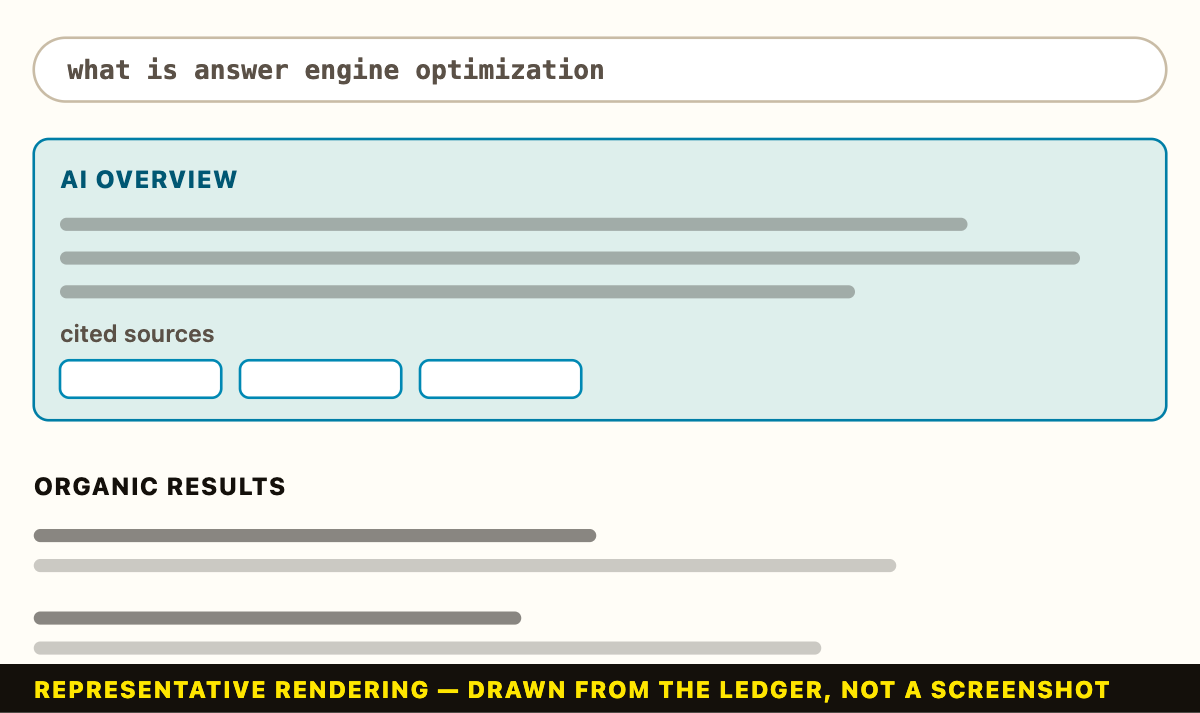
What this page optimizes for: a synthesized answer that satisfies the query inline. Informational intent is the cheapest volume to answer with a model, and question-format queries get the highest synthesis rate measured here — keeping the session from ever reaching a competing result.
Google's own 10-K states it plainly: more than 70% of Alphabet's total revenue came from online advertising in 2025. Its interface keeps the session inside it — every click away risks a slower page, the wrong answer, or a worse experience. (Alphabet Inc. Form 10-K, FY2025.)
Commercial investigation — the shortlist Google monetizes twice
Scale: Same global anchor as every intent here — more than 5 trillion searches a year (Google, blog.google, 3 March 2025). No source breaks that down by US commercial-investigation volume specifically.
8% of commercial-investigation queries trigger an AI Overview overall — but 95.4%, the highest rate anywhere in this dataset, when the query is a direct comparison: "X vs Y." (Seer Interactive, 267 of 280 comparison queries, published 24 April 2026.) AI Overview presence on commercial SERPs grew 71% in the six months to April 2026, led by finance at +231.25%. (Semrush, 600,000+ keywords / 10 industries, published 2 July 2026.)
Paid took what organic lost. In the US headphones category, combined paid click share went 16% → 36% in one year while organic fell 73% → 50% (Search Engine Land / Aleyda Solis, Similarweb data, Jan 2025 vs Jan 2026, published 18 February 2026) — the same direction, smaller scale, across jeans, greeting cards and online games in the same study.
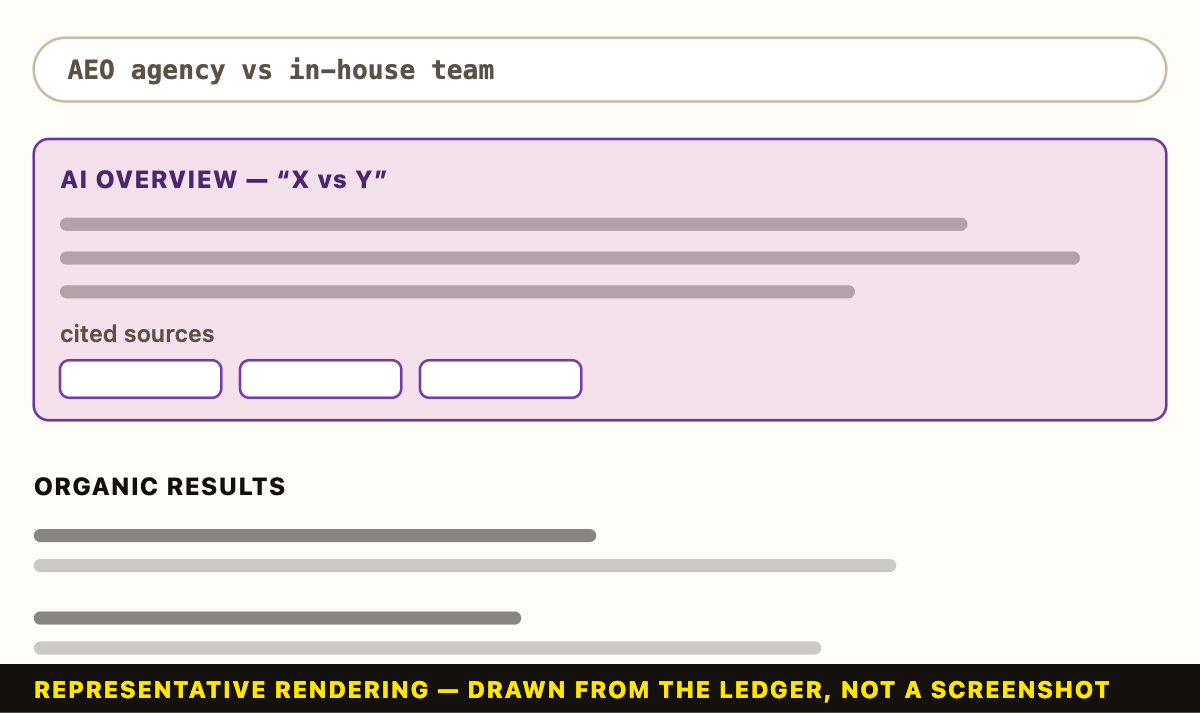
What this page optimizes for: an extended shortlist. AI synthesis frames the comparison, paid units monetize it, both on one page, selling the same attention twice — commercial-investigation traffic prices higher per click than any other intent.
The same incentive holds at a higher price: more than 70% of Alphabet's 2025 revenue was online advertising (Alphabet Inc. Form 10-K, FY2025), and a session that stays on-SERP outvalues one that leaves after the first click.
Transactional — the one intent moving away from AI synthesis
Scale: Against Google's own more-than-5-trillion-a-year total (blog.google, 3 March 2025), no publisher has measured what share of US transactional queries that represents.
5% — under 1 in 20 transactional queries trigger an AI Overview, the lowest of the three intents Seer tracks this way, and the only one moving backwards: -5% between November 2025 and April 2026, while commercial-investigation AI Overviews grew 71% in the same window. (Seer Interactive; Semrush, published 24 April 2026 and 2 July 2026.) Organic CTR when present-but-uncited fell 48% across the tracking window — 4.17% down to 2.15% by December 2025 — and being cited (1.65%) did not clearly beat being uncited here, the one intent in this dataset where that pattern breaks. (Seer Interactive.)
Purchase-intent queries stayed under 2.1% of tracked activity across 41 high-traffic sites in 2025 (SparkToro with Datos — summary-sourced, medium confidence).
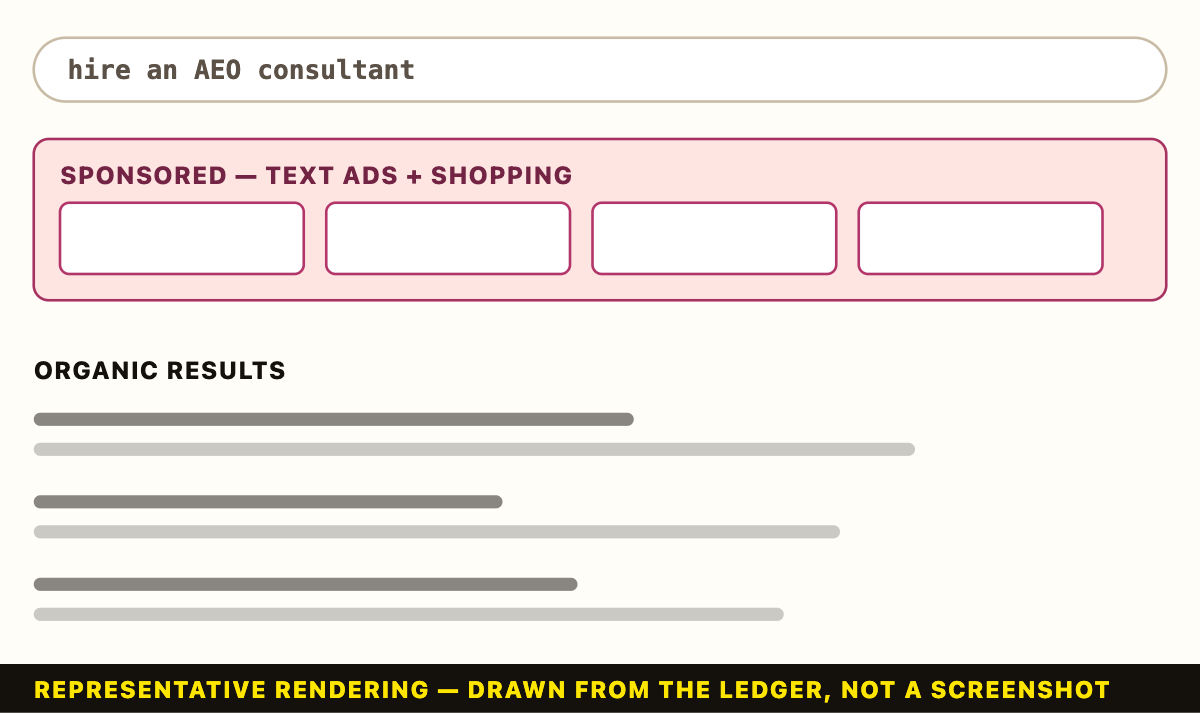
What this page optimizes for: the shortest path to a completed transaction. Google has the least incentive to insert a synthesized answer between a ready-to-buy searcher and the ad or Shopping unit that converts — consistent with the lowest, and still-falling, AI Overview rate of any intent measured.
Even on a ready-to-buy query the incentive doesn't flip. Alphabet's own 10-K states more than 70% of its 2025 revenue came from online advertising — every click away risks a destination slower or worse than what Google could have kept showing.
Navigational — the intent that needed AI least, and got it anyway
Scale: Google's total is more than 5 trillion searches a year, globally (blog.google, 3 March 2025) — navigational's US share of it has not been measured in anything found for this piece.
0% AI Overview trigger rate in a late-2024 sample of 10,000 US desktop keywords (Authoritas, published January 2025) — then 0.84% → 10.33% in Semrush's 2025 tracking, roughly a twelvefold rise in the one intent that least needed a synthesized answer in the first place (Semrush, 10M+ keywords, published 2 February 2026).
Navigational SERPs stay structurally simple — one dominant brand result plus sitelinks — which is exactly why a near-zero starting rate could climb this fast without anyone calling it a trend: there was no floor to fall through.
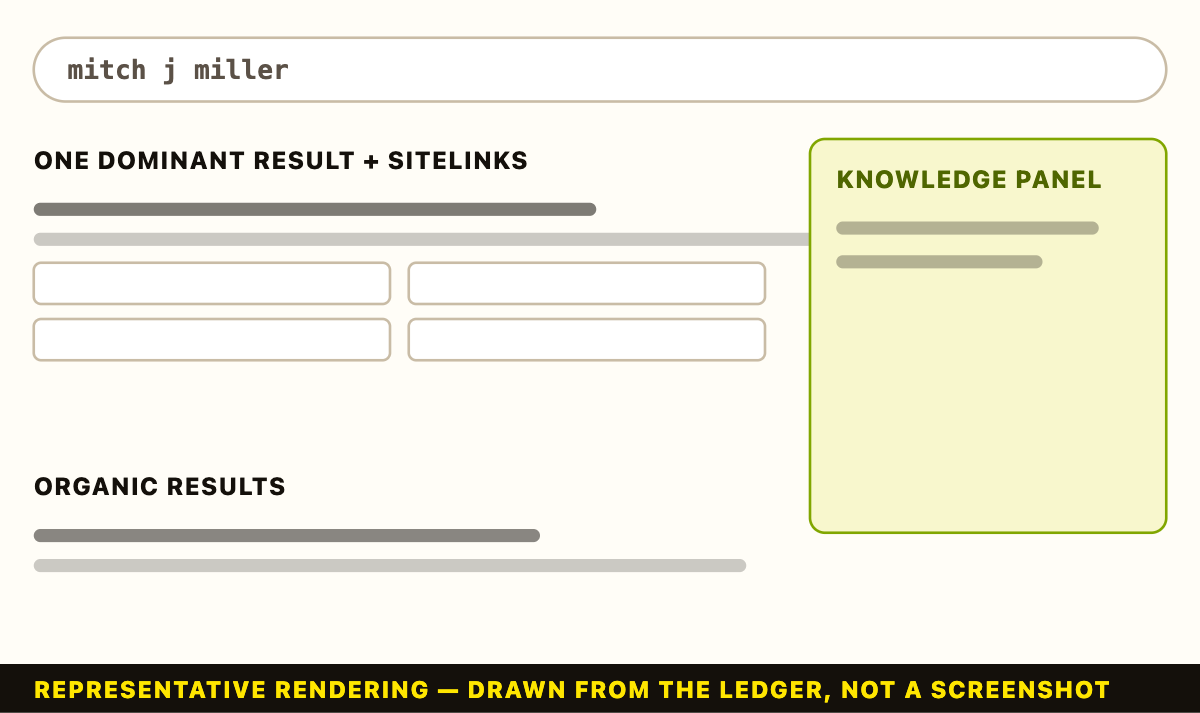
What this page optimizes for: routing, at the lowest possible serving cost. One confirmed destination, sitelinks instead of synthesis — no ambiguity to resolve and no comparison to sell ads against.
Navigational is where this incentive is weakest — the destination is already decided — but the fact underneath doesn't change: Alphabet's 2025 10-K reports more than 70% of total revenue from online advertising, so even a brief on-platform session still counts toward the same business.
Local — the intent Google never has to hand off
Scale: The same 5-trillion-plus global total applies (Google, blog.google, 3 March 2025); a US-only local-intent share of it isn't published anywhere found for this piece.
15% of local-intent queries trigger an AI Overview — the lowest structural rate measured here — against 92% for informational and 97% for hybrid-intent queries within that same local-services study. Local Pack presence: 93% on local-intent queries, versus 6% on informational-only queries and 39% averaged across all query types in the same study. (Whitespark, 540 queries / 3 US metros / 6 verticals, hand-collected, published 12 May 2025.)
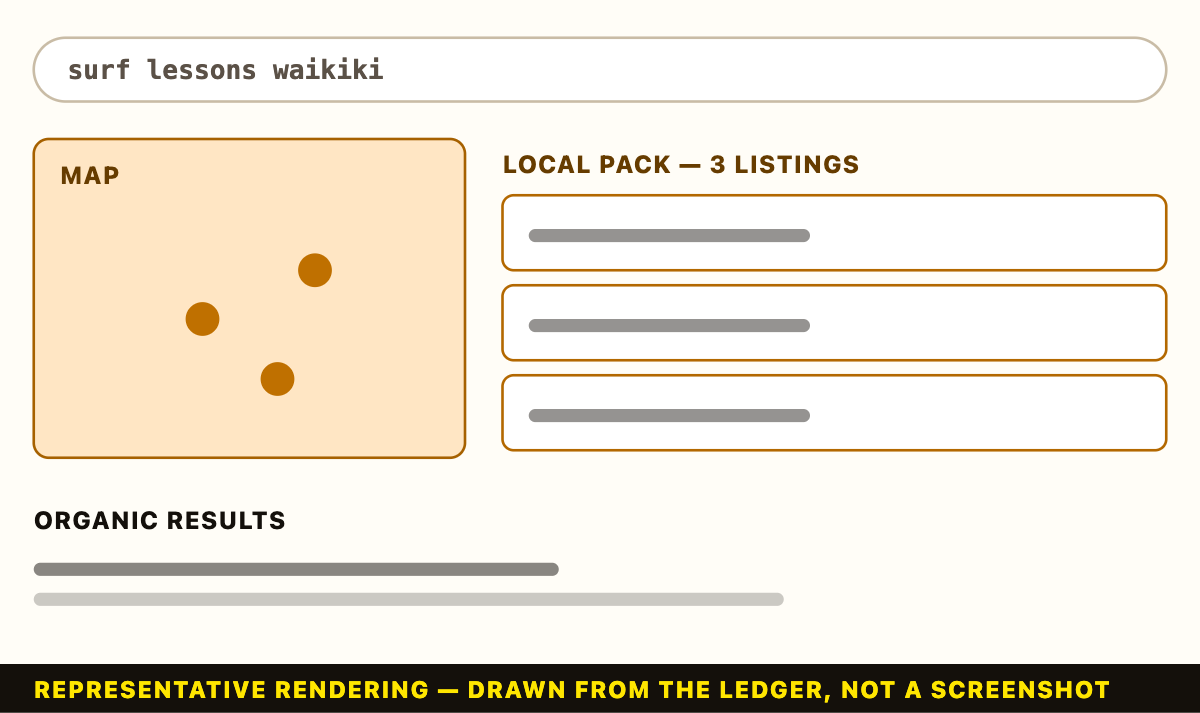
What this page optimizes for: keeping the transaction — the call, the directions, the booking — inside Google's own Maps and Local Pack surface rather than sending the click to a website at all. Success here looks least like a click and most like a completed action Google never had to hand off.
Local is where this incentive is most visible: a call or a set of directions completed inside Maps never has to survive a destination page that loads slow or disappoints off-platform — and more than 70% of Alphabet's 2025 revenue, per its own 10-K, was online advertising in the first place.
The route through all five
Lay the five pages end to end and they form a route: a session moving from a synthesized answer, through a monetized shortlist, toward a transaction Google would rather keep on-platform — navigational and local are the two stops where a click was barely the point. The journey map below draws that route, ending where 68.01% of sessions already do.

The zero-click future SEOs measured before it had a name
Search strategists — SEOs especially, organic and paid both — were not caught off guard by zero-click. SparkToro's own tracker puts US Google zero-click share at roughly 45% in 2016, 49% in 2019, 60.45% in 2024 and 68.01% this year — that last jump, 7.56 points in two years, moved faster than the prior eight-year trend. Ahrefs' 58% click-tax figure updates its own April 2025 study; Seer Interactive's is the third edition of a recurring one — a measured decade, run by people who publish methodology, not a narrative that arrived with a phrase attached.
Google's own team, meanwhile, described the result as "relatively stable year-over-year" click volume (Liz Reid, VP, Head of Google Search, blog.google, 6 August 2025) — eleven days after Pew Research's independent tracking panel measured a standard organic result clicked on 8% of visits when an AI summary was present, versus 15% when it wasn't, with only 1% of visits clicking a link inside the summary itself (Pew Research Center, 900 US adults tracked in March 2025, published 22 July 2025). Neither source cites the other.
The next measured shift is agentic, and it resists a single number as hard as intent share does. 51% of US shoppers would let AI run the entire purchase — including the final transaction — once their preferences are set, rising to 59% among Millennials specifically (Adyen 2026 US Retail Report, 9 January 2026). 58% say they've already replaced search engines with generative AI for product and service recommendations, up from 25% two years before (Capgemini Research Institute, 9 January 2025). Trust drops hard once real money moves: only 14% actually trust AI to place an order on their behalf (Bain & Company, 2025). Interest in delegating clusters in the 50s; trust in the completed transaction sits in the teens — that gap is the finding, not an average of the two.
A near-zero-click result does not make the underlying website less important — it makes the paths to it narrower and more scrutinized. Being cited inside an AI Overview is worth roughly +120% more organic clicks per impression than appearing and not being cited (Seer Interactive) — same rank, same page, different outcome. Brand visits, agent-initiated checkout and AI citations all still resolve to a site: Stripe's Instant Checkout inside ChatGPT routes to named merchants (Etsy live at launch, Shopify and its 1M+ merchants including Glossier and Vuori announced to follow), and Google's Universal Commerce Protocol was built on the same principle, naming Shopify, Etsy, Wayfair, Target and Walmart as launch partners (Stripe newsroom, 29 September 2025; Google Developers Blog, 11 January 2026). The click moved earlier or later in the session rather than disappearing.
That raises the bar on authority, authenticity and trustworthiness rather than lowering it — the same "expertise, experience, authoritativeness and trustworthiness" elements Gartner told brands to keep demonstrating in the same forecast that predicted a 25% drop in search volume by 2026 (Gartner, analyst Alan Antin, 19 February 2024). And the gatekeeper is no longer singular. Profound's 680-million-citation study found Google AI Overviews' top cited source (Reddit, 2.2% of citations) barely overlaps with ChatGPT's (Wikipedia, 7.8%) or Perplexity's (Reddit, 6.6%) (Profound, Aug 2024–Jun 2025 window), and Semrush watched Reddit's own share of ChatGPT's citations fall from roughly 60% in early August 2025 to about 10% by mid-September 2025, around a single platform change (Semrush, 230,000+ prompts, published 10 November 2025). Three platforms, three reference libraries, one rewriting itself in six weeks — "rank well" was never one instruction.
Optimizing for citation differs from optimizing for ranking — covered in the AEO visibility work, not repeated here. The next piece in this series takes the layer above citation: what it means that free ChatGPT answers are starting to carry ads. Optimizing for ads in free LLM answers — coming.
Share this with someone budgeting 2027 content against a search-intent split that hasn't been remeasured since 2008.
FAQ
How often does an AI Overview appear, by search intent?
It depends on the panel and the query pattern inside it. Seer Interactive's 5.47M-query study measured 36% for informational, 8% for commercial investigation and 5% for transactional, published 24 April 2026. That same study found comparison-format ("X vs Y") queries trigger one 95.4% of the time — the highest rate in any panel checked here. Whitespark measured 15% for local intent and 92% for informational queries inside local-service verticals, published 12 May 2025. Navigational intent moved from roughly 0% (Authoritas, Dec 2024) to 10.33% (Semrush, 2025 tracking) — even the intent least likely to need an answer picked one up.
Do AI Overviews reduce organic clicks?
The two largest disclosed samples say yes, clearly. Ahrefs measured a 58% drop in position-one CTR on AI-Overview keywords, 300,000 keywords via Search Console, published 4 February 2026 — nearly double the 34.5% it measured eight months earlier. Seer Interactive measured 0.94% organic CTR when an AI Overview is present and the brand is not cited, against 3.35% with no AI Overview at all, and 2.07% when cited. Transactional intent is the exception worth naming: there, being cited (1.65%) did not clearly outperform being uncited (2.15%).
What share of searches is informational, commercial, transactional, navigational or local in 2026?
No modern full-sample answer has been published for any of the five. The 80/10/10 split still in wide circulation comes from a 2008 study of 1.5 million queries. Until a full-sample panel covering all five intents is published, treat any confident 2026 intent split as an estimate rather than a measurement.
Does a near-zero-click search result make a website's own content less important?
No — it makes the paths into that content narrower. Citation inside an AI Overview is worth roughly +120% more organic clicks per impression than presence without citation (Seer Interactive), and brand visits, agent-initiated purchases and AI citations still resolve to a site even when the search itself produced no click. What changes is which signals earn the citation in the first place, which is why authority and verifiable trust signals matter more under measurement, not less — see the AEO visibility work for how that gets built.
Sources
- SparkToro — In 2026, less than one third of Google searches still send a click. Similarweb clickstream panel, US, Jan–Apr 2026, with the publisher's own 2016–2026 tracking series. Published 9 June 2026.
- SparkToro — Search Happens Everywhere: 41-website analysis, with Datos. Published 2025.
- Ahrefs — AI Overviews reduce clicks (2026 update). 300,000 keywords, Search Console, Dec 2025 vs Dec 2023. Published 4 February 2026.
- Ahrefs — AI Overviews reduce clicks (original). Published April 2025.
- Ahrefs — Goodbye, Featured Snippets: How SERP Features Have Evolved in the AI Era (Ryan Law). 1,000,000 US desktop SERPs, January vs June 2025. Published 22 July 2025.
- Seer Interactive — AIO impact on Google CTR: 2026 update. 5.47M queries, 53 brands, Jan 2025–Feb 2026. Published 24 April 2026.
- Whitespark — The prevalence of AI Overviews in local search. 540 queries, 3 US metros, 6 verticals, hand-collected. Published 12 May 2025.
- Semrush — AI Overviews are expanding across commercial intent search. 600,000+ keywords, Nov 2025–Apr 2026. Published 2 July 2026.
- Semrush — SERPs with ads and AI Overviews grew over 394% in 2025. 10M+ keywords. Published 2 February 2026.
- Semrush — Most-cited domains in AI: a 3-month study. 230,000+ prompts, 100M+ citations, Jul–Oct 2025. Published 10 November 2025.
- Authoritas — How user intent drives AI Overview appearance rates. 10,000 US desktop keywords, collected Dec 2024. Published January 2025.
- Search Engine Land / Aleyda Solis — Paid search click share doubles as organic clicks fall. Similarweb data, 4 US categories, Jan 2025 vs Jan 2026. Published 18 February 2026.
- Search Engine Land — 80% of searches are informational (Penn State / Jansen). 1.5M+ queries. Published 10 April 2008.
- Profound — AI platform citation patterns. 680M citations, Aug 2024–Jun 2025.
- Google — AI, personalization and the future of shopping (Vidhya Srinivasan). "More than 5 trillion searches on Google annually." Published 3 March 2025.
- Google — AI in Search is driving more queries and higher quality clicks (Liz Reid). Published 6 August 2025.
- Alphabet Inc. — Form 10-K, fiscal year 2025. "More than 70% of total revenues from online advertising in 2025." SEC EDGAR.
- Pew Research Center — Do people click on links in Google AI summaries? 900 US adults, KnowledgePanel Digital, tracked March 2025. Published 22 July 2025.
- Adyen — 2026 US Retail Report. Censuswide, n=2,000 US adults 16+, fielded Nov–Dec 2025. Published 9 January 2026.
- Capgemini Research Institute — 71% of consumers want generative AI integrated into their shopping experiences. n=12,000, 12 countries. Published 9 January 2025.
- Bain & Company — Agentic AI commerce hinges on consumer trust. 2025.
- Gartner, Inc. — Gartner predicts search engine volume will drop 25% by 2026 (analyst Alan Antin). Published 19 February 2024.
- Stripe Newsroom — Stripe powers Instant Checkout in ChatGPT and releases Agentic Commerce Protocol codeveloped with OpenAI. Published 29 September 2025.
- Google Developers Blog — Under the Hood: Universal Commerce Protocol (UCP). Published 11 January 2026.