this is the single clearest map of the lane I'm building toward — the person who sits between a messy business and the AI stack and makes intelligence actually land. It's the same "harness over model" thesis I keep circling, aimed at a *job* with a number on it ($150K→$1M). The 30-day plan is a build-your-own-proof roadmap, and I turned the whole method into a reusable skill my agents can run.
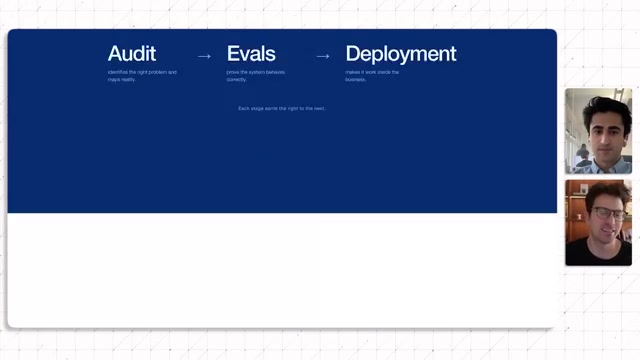
Every company can now buy the same intelligence — the frontier models ship weekly and everyone runs the same stack (Claude Code, Codex, Cursor, Copilot). So intelligence stops being the moat; the edge moves to deployment: applying general intelligence to one company's specific, messy processes. The person who does that is the Forward Deployed Engineer — a Palantir-coined role that's now the hottest job in tech. It pays because it demands a rare combination: consultant + engineer, art + science, in one person. The work is a repeating loop — audit → evals → deployment — and Vas Moza lays out a 30-day plan to build the proof solo and "do the job before you have the title." Why most AI spend fails: companies bought intelligence and skipped deployment (~95% of GenAI pilots fail; one exec torched a $10M budget in 3 months "token-maxing").
Key takeaways
Intelligence is commoditized. Same models, same stack, available to anyone who pays. The moat is no longer who has intelligence — it's where, how, and why they deploy it.
The FDE is the bridge. Between the business reality and the intelligence stack. Whoever builds the best bridge wins — that's the role.
It's the best-of-both, not the average. Left aisle = consulting (workflows, incentives, risk, adoption, politics). Right aisle = engineering (models, evals, guardrails, harnesses). The $1M hire is genuinely strong on both.
Documented process ≠ real process. "An email arrives" is really 40+ senders, PDFs/screenshots/Excel, half exceptions, routing logic living unwritten in one person's head. You only get it by sitting on-site.
Judgment is the job: where does intelligence belong — and where not? Majority deterministic software, LLM only at real judgment nodes, human-in-the-loop before irreversible actions.
The audit is the wedge — worth 10× its price, "better than McKinsey." Rebrand it ("sprint"), do the first one free to de-risk, get paid on results.
Build on top of what exists. Never force a migration off their ERP — you'll get thrown out. Integrate, then stage: test → shadow → autonomy → production.
Measure only three buckets: revenue uplift, risk mitigation, cost savings. No number in one of them = no proof.
Build for the unhappy paths. "One way it goes right, a thousand ways it goes wrong. Build only the happy path and you're worth nothing."
"The edge is no longer who has the intelligence. It's where, how, and why they use it." — Vas Moza
What an FDE actually is
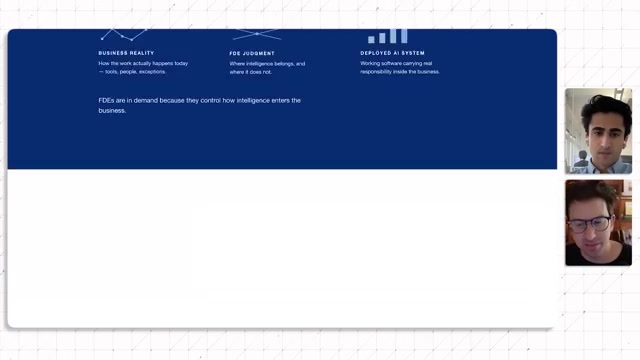
The term comes from Palantir (originally a military term — engineers deployed forward, to the field). Palantir built an ontology + data-lake platform whose real power wasn't how tech-forward it was — it was how customizable it was. FDEs deployed on-site with enterprise and government clients, learned their workflows, and spun up the dashboards and agents that solved their specific problems. Consulting, but for software. Vas's thesis: if it worked for Palantir in the data age, the AI age demands it 100× more — every company will need customized agents, and the FDE is why AI actually becomes useful to a business.
It runs in three stages, and each one feeds the next:
[14:58]
"If you understand art and understand science and you can speak both, you have what it takes." Lean one way? Deliberately drift toward the other.
Stage 1 — understand the business reality
This is where the bulk of the time goes, and where tech people get it wrong. The documented process is almost never the real one. Vas's example: an email arrives. Sounds like a clean trigger. It isn't.
Why FDEs go on-site: you sit with the operator all day, build the relationship, and watch the exceptions no SOP ever captured.
Go on-site (or deep-remote when you must). A one-hour meeting gets you the person's idea of the job; a full day gets you the job — including what breaks and how they quietly fix it. Interview multiple people; the same workflow usually spans several heads.
Stage 2 — FDE judgment: where does intelligence belong?
The early-AI reflex was "slap AI everywhere, let the model figure it out" — token-maxing. That's what produced the hallucinations, the blown budgets, and the ~95% pilot-failure rate. The FDE's real value is deciding, step by step, where intelligence actually belongs.
Not every workflow deserves AI — too risky, low ROI, or already automated. Naming where it does NOT belong is half the judgment.
Stage 3 — deploy, and the audit that opens the door
Stage 3 is build → evals → deployment. But the thing that gets you in the room is the audit.
[27:08]
Every engagement starts with a paid audit that maps each workflow, its exceptions, and an ROI matrix of what's worth automating. Clients have said the audit alone was worth 10× what they paid — "better than McKinsey," because AI is new enough that no one else can map it. Practical moves:
Rebrand "audit." People react to the word like a tax audit. Call it a sprint, a current-state analysis, current vs. future state.
De-risk yourself. To the buyer, you are the risk — status quo is safe; you might fail and make them look bad. Do the first audit free, prove value, get paid on results. Your first 1–3 clients teach you more than you give them.
Sell to the human. They don't want to get fired; they want to get promoted. Help them point to "I drove this value" at review time. Pitch value cost-effectively — not "rip out your ERP."
Build on top of what exists. A client spent years and millions moving to NetSuite; tell them to leave it and you're gone. Integrate on top, connect the rest (Salesforce, SAP, Concur, Workday, Gong), then stage the rollout: test → shadow mode → increasing autonomy → production.
Audit trail is non-negotiable. If you can't show the client what the agent did — logged, inspectable traces — they will never trust you.
The 30-day plan: do the job before you have the title
You can't get embedded without being an FDE first — so build the proof solo. One focus per phase; space it out if 12-hour days aren't realistic.
Day 30: you understand FDE work AND have evidence you can do it. The evidence is what gets you the shot.
Measure only the three buckets
An agent's value always reduces to the same three numbers. If you can't put a figure in at least one, you haven't proven anything.
On models: as a company, stay agnostic. As a beginner FDE, master ONE model + ONE agent platform first — your value is understanding both aisles, and that transfers.
My take
This maps almost one-to-one onto what I'm already building — the Content Studio, the Hermes router, the "own your context, invest in the harness" thesis. The reframe that stuck: the money isn't in the intelligence, it's in making it land inside one specific, messy business — and that's a communication job as much as an engineering one. The 30-day plan is the useful part: it's a concrete way to manufacture proof before anyone hands you the title. I turned the whole method into a reusable forward-deployed-engineer skill so any of my agents can run an engagement to the same checklist.
Worth a healthy dose of salt: as the comments point out below, a lot of this is a rebrand of the systems-analyst / business-analyst / solutions-engineer / management-consultant role that's existed for decades — and both guests have something to sell (Verity Agents; a hinted-at paid program). The novel part is real, though: super-intelligence on tap genuinely is new, and "someone has to decide where it belongs" is a genuinely different job than it was five years ago.
🗣️ The Buzz — what the audience actually said
150 comments · 891 likes · paraphrased, ranked by likes
Prevailing sentiment: unusually high-signal and enthusiastic — a lot of "one of the best episodes of the year," people literally committing to the 30-day plan, and AI-consultants saying it reframed how they position their work. The sharpest and most-upvoted pushback is a chorus of practitioners insisting the FDE is a rebrand of the systems-analyst / business-analyst / solutions-engineer / management-consultant role that's existed for decades. Others add useful history (it's a Palantir/military term) and one insider caution that Palantir FDEs are often clueless juniors. Loud demand for a paid 30-day course. Bots/spam ~0%.
🏛️ 200 likes · @MarkShustFrom someone doing the work: the term "forward deployed engineer" draws a puzzled look every time he says it — the label is confusing even to practitioners.
🚩 120 likes · @kdsummersutube"Those of us who've done this a long time remember when we were called systems analysts — the person who understood the business, the processes, and the tech." (i.e. not new.)
🔧 115 likes · @vasmoza (guest)Vas Moza (Verity Agents), the guest, thanking Greg for having him on. Confirms the source.
👍 97 likes · @funni_content"People focus too much on tactics and not enough on positioning." The FDE framing is as much psychological/positioning as technical.
🚩 49 likes · @Bigeyes4535Blunt version of the top critique: "This is just a mix of a business analyst and a solution engineer."
👍 38 likes · @DavidCasperson"Vas summarized in 45 minutes how to combine the old-school BCG/McKinsey/Deloitte consulting mindset — onsite, talking with humans — with modern AI." High praise for the synthesis.
🏛️ 26 likes · @marklatture"Forward Deployed Engineer is a military term — that's why Palantir used it. It's been my job for 15 years: contractor deployed to remote overseas military bases."
👍 17 likes · @Minierai-b8h"I'm in — I'll follow this 30-day plan all the way through. Strong infra + AI background, and this is the first roadmap that actually feels executable."
🚩 15 likes · @RebeccaPierce-g4dHalf-agrees there's no title yet, but frames the role as "someone paid a lot to identify, validate and deploy" — i.e. the work is real even if the name is new.
🚩 13 likes · @CosmicLoveLetters"Sounds like an FDE is what we called a business analyst in the pre-AI era."
❓ 11 likes · @broadbrah92"As someone starting an AI consulting business this is literally a golden playbook. I'd pay for an in-depth breakdown of the 30-day course." (The recurring ask.)
👍 5 likes · @RyanStephenAlldridge"One of my favorite episodes of the year. Also reframes how I'm positioning my AI consulting work here in Tokyo."
👍 3 likes · @MadHolms"The part about building for the unhappy paths hit different — 'one way it goes right, 1000 ways it goes wrong' is the most honest thing said in the video."
👍 2 likes · @falcobridge"The million-a-year headline does the clicks, but what stuck is the shape of the role — someone who sits between the messy problem and the tech and translates."
🏛️ 3 likes · @phonomorgue.1372Insider cold-water: "I work with FDEs from Palantir and they're clueless 2–3 YoE juniors, usually." A caution against the mystique.
❓ 2 likes · @cjdobrezA mid-size-company CEO: "I plan to spin up this capability in my org" — demand from the buy side, not just aspiring FDEs.
🤖 pinned · @GregIsenberg (creator)Creator's pinned comment linking the "FDE Starter Guide" (gregisenberg.com/fde) — the commercial hook behind the free episode.
🤖 Bot/spam estimate: ~0%. Method: heuristic scan of 150 comments for links, crypto/giveaway scams, emoji-only, generic-praise templates and duplicates — found only 1 creator promo link (the pinned FDE guide) and no clear bots. Unusually organic thread. Disclosed estimate, not certified detection.

 [14:58]
 [27:08]